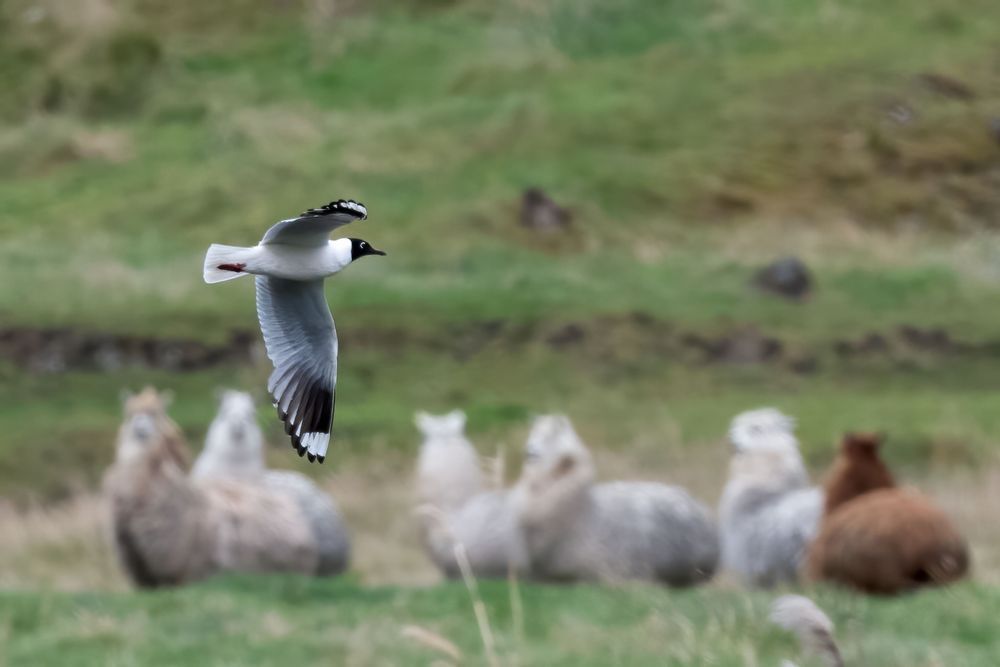
In the open páramo of Cajas National Park, an Andean Gull flies low across alpine grassland during September, a period corresponding with the late dry season in the southern Ecuadorian Andes. At elevations near 3,900 meters (12,800 ft), the landscape consists of windswept grasslands, glacial lakes, and scattered wetlands shaped by cold temperatures, intense ultraviolet radiation, and persistent mountain winds. Andean Gulls are among the few gull species regularly occupying such extreme elevations, moving between high-altitude lakes and marshes scattered throughout the páramo ecosystem. The bird’s broad wings and efficient flight allow it to travel across thin mountain air while searching for aquatic prey, invertebrates, or carrion along alpine shorelines. In Andean grazing landscapes, gulls are also known to move over areas where alpaca or other camelids feed, taking advantage of insects and small invertebrates disturbed by grazing activity. This moment captures the species moving across the open Andean landscape above grazing alpaca in the high-elevation grasslands, illustrating how wildlife, traditional pastoral land use, and native bird species coexist within the páramo ecosystem of the Ecuadorian Andes.
Identification: A medium-sized gull with a black hood, white body, pale gray wings with black tips, and red bill and legs.
Habitat: High-elevation Andean lakes, wetlands, and surrounding páramo grasslands often used for traditional alpaca grazing.
Geographic Range: High Andes of Ecuador, Peru, Bolivia, Chile, and northwestern Argentina.
Interesting Behavior or Note: Andean Gulls frequently forage inland at alpine lakes and wetlands and may follow grazing camelids where disturbed insects provide additional feeding opportunities.
Location: Cajas National Park, Ecuador
Elevation: ~3,900 m (12,800 ft)
Date: 2021-09-20
For the Technically Inclined:
Camera: Nikon D850 | Lens: NIKKOR 500mm f/5.6E PF | Focal Length: 500 mm | Shutter Speed: 1/1000 | Aperture: f/8 | ISO: 800 | Support: Handheld