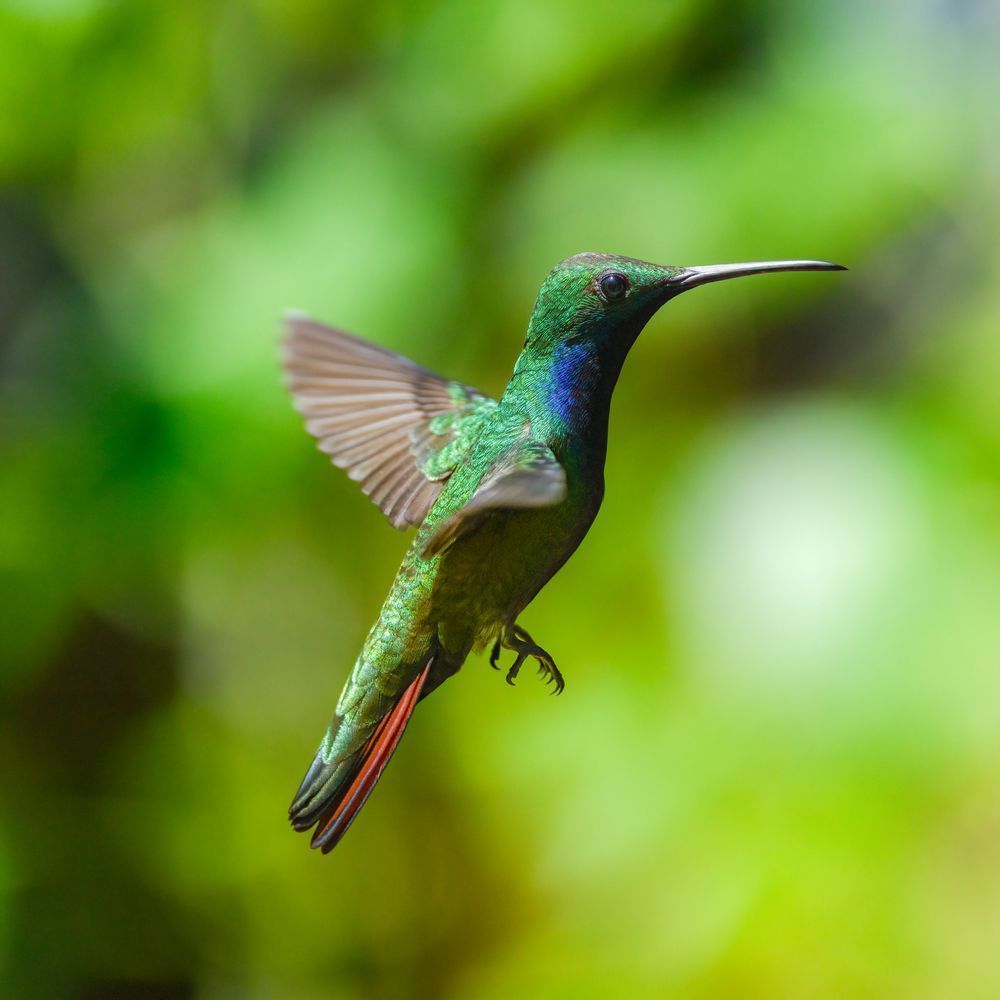
Photographed at Jardín de los Picaflores near Iguazú, Argentina, this image captures a Black-throated Mango suspended in mid‑air as it navigates the flowering gardens bordering the Atlantic Forest. Late austral spring brings a surge of flowering plants across the region, creating rich feeding opportunities for hummingbirds and intensifying their activity. The species’ signature hovering flight allows precise positioning while feeding, powered by rapid wingbeats and a remarkably high metabolism. Set against the luminous greens of the forest edge, the metallic plumage and dark throat patch of this hummingbird create a vivid portrait of life in one of South America’s most biologically diverse ecosystems.
Identification
The Black‑throated Mango is a medium‑sized hummingbird with metallic green upperparts, a distinctive dark throat patch bordered by iridescent blue or violet tones, a long slightly decurved bill, and reddish tones visible in the tail.
Habitat
Subtropical forest edges, gardens, and flowering clearings within the Atlantic Forest region.
Geographic Range
Widespread across tropical South America from Panama south through Brazil, Paraguay, and northeastern Argentina.
Interesting Behavior or Note
Black‑throated Mangos frequently visit flowering gardens and forest edges where nectar sources are concentrated, often hovering briefly before shifting rapidly between flowers.
For the Technically Inclined
Camera: Nikon D850 | Lens: NIKKOR 500mm f/5.6E PF | Focal Length: 500mm | Shutter Speed: 1/5000 | Aperture: f/5.6 | ISO: 1100 | Support: Handheld
Location: Jardín de los Picaflores, Iguazú, Argentina
Date: 2022‑11‑05