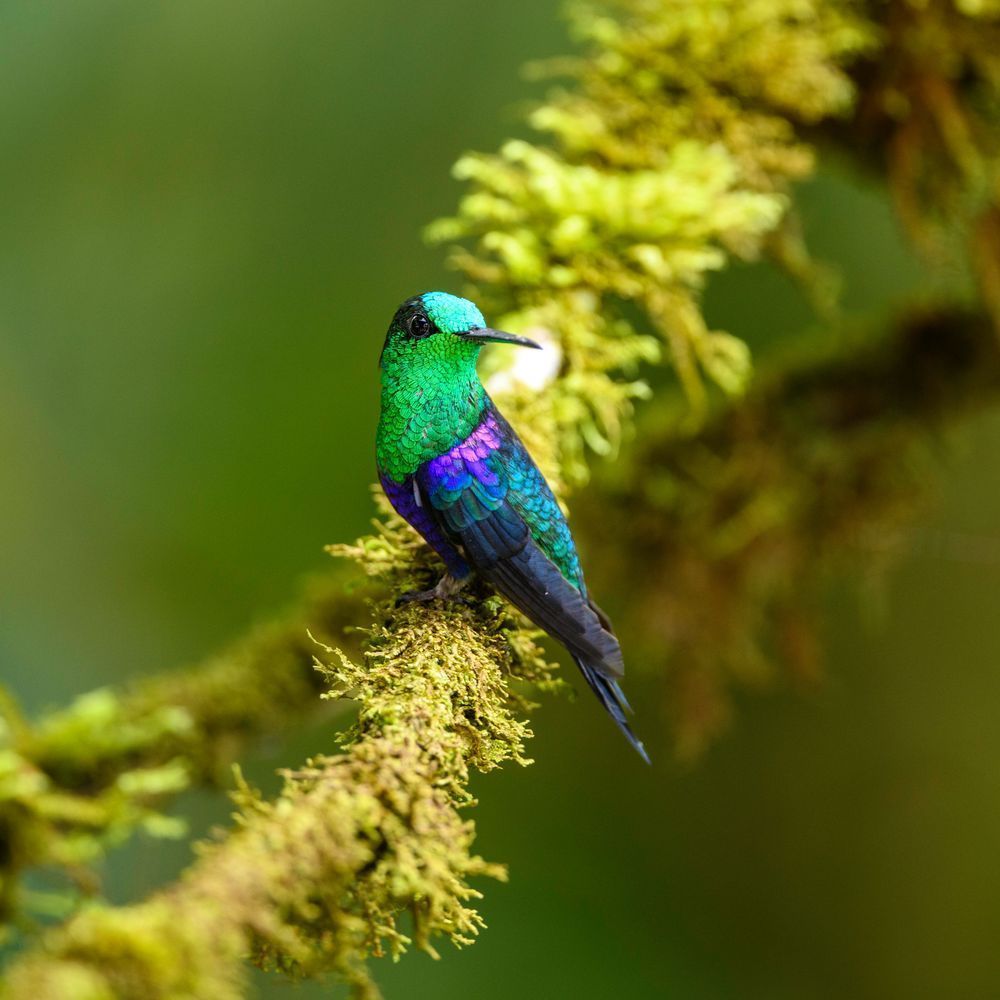
Green-crowned Woodnymphs, scientifically known as Thalurania, are captivating medium-sized hummingbirds that grace the lush and vibrant ecosystems of Central and South America. Distinguished by their slightly decurved, black bills, the males of this species are further characterized by a forked tail and a resplendent throat and belly that shimmer like polished emeralds. Among the woodnymphs, the Green-crowned Woodnymph stands out as the sole representative of its genus in the region, occupying a range that extends from eastern Panama down to the southwestern reaches of Ecuador.
Their choice of habitat mirrors their exceptional beauty. Green-crowned Woodnymphs find refuge in the understory of humid lowland forests, as well as in adjacent advanced second-growth areas. These charismatic hummingbirds often populate their chosen habitats, and their presence is a testament to the remarkable biodiversity of these regions. The species adapts well to environments such as tall second-growth areas, overgrown clearings, and semi-open landscapes like coffee and cacao plantations and shaded gardens. They generally steer clear of open, scrubby terrains.
In essence, Green-crowned Woodnymphs are not only avian marvels for their striking appearance but also fascinating examples of ecological adaptation, seamlessly navigating the rich tapestry of tropical environments in Central and South America.
The Green-crowned Woodnymphs was photographed at the Milpe Bird Sanctuary, Mindo, Ecuador on September 28, 2021
Camera settings:
500mm | f/5.6 | 1/160 | ISO 720
Nikon D850, Nikon 500mm f/5.6