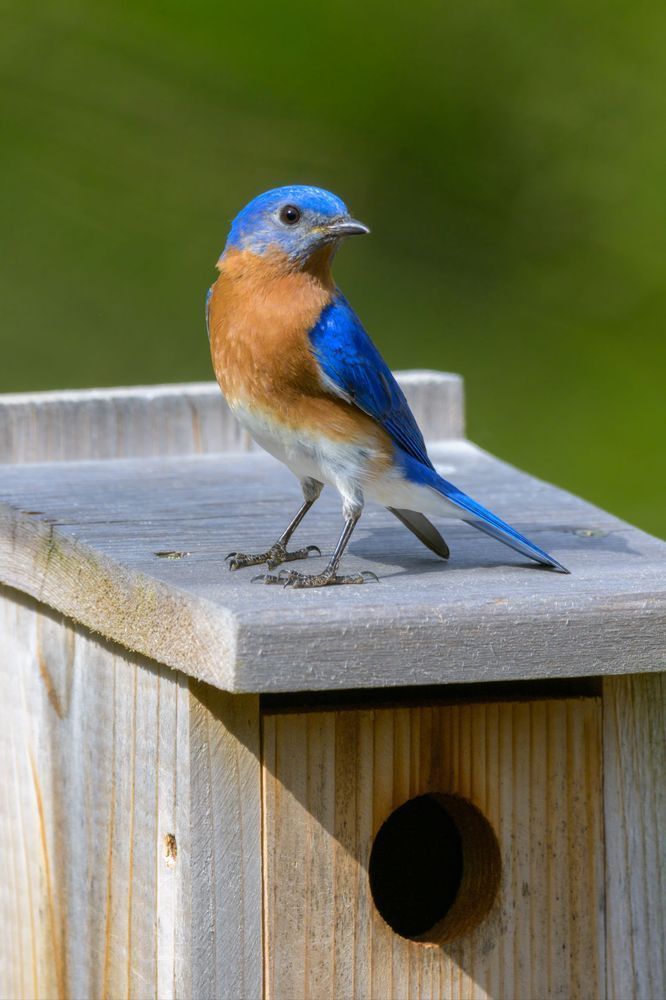
In early March in western North Carolina, Eastern Bluebirds begin establishing breeding territories and evaluating nesting cavities. This individual stands on the roof of a nest box, a typical vantage point used while inspecting potential nesting sites. Nest boxes frequently substitute for natural tree cavities in open residential landscapes, where bluebirds benefit from maintained fields, lawns, and scattered perches that support abundant insect prey. The timing of this behavior corresponds with the early phase of the breeding season in the southern Appalachian region, when pairs investigate multiple cavities before selecting a final nesting site. Perching above the entrance allows the bird to assess the cavity and surrounding territory while maintaining visibility of nearby activity.
Identification: A small thrush with bright blue upperparts, warm rufous chest, and pale belly. Males show especially vivid blue coloration on the head, wings, and back.
Habitat: Open woodlands, fields, pastures, and residential landscapes that provide scattered trees or nest cavities along with open ground for foraging.
Geographic Range: Eastern North America from southern Canada through the eastern United States into parts of Mexico.
Interesting Behavior or Note: Eastern Bluebirds readily use artificial nest boxes, which have helped the species recover after historic declines caused by habitat loss and competition from introduced cavity-nesting birds.
Location: Franklin, North Carolina
Elevation: ~670 m (2,200 ft)
Date: 2026-03-15
For the Technically Inclined:
Camera: Nikon Z9 | Lens: NIKKOR 600mm f/4E FL + TC-14E III | Focal Length: 850 mm | Shutter Speed: 1/1600 | Aperture: f/5.6 | ISO: 280 | Support: Gitzo Series 5 tripod