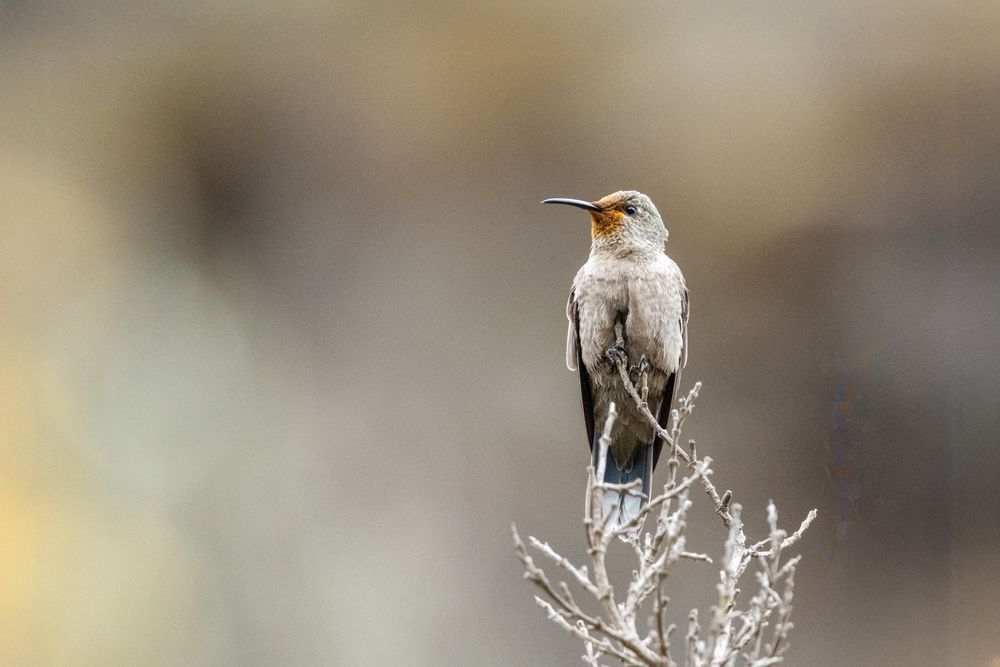
The Ecuadorian Hillstar is a true specialist of the high Andes—built for life above treeline where wind, cold, and open space define every movement. In this frame from Cajas National Park (3,100–4,450 m / 10,170–14,600 ft), the bird holds a quiet, exposed perch against a soft alpine backdrop, its buff-orange throat catching the light while the rest of the landscape falls away into subdued tones. It’s a moment of stillness in a habitat where hovering is costly and rest has purpose—an image that feels minimal, wild, and unmistakably Andean.
Identification
Medium-sized high-Andean hummingbird with a straight to slightly decurved bill, pale gray underparts, darker wings, a warm buff-orange throat patch, and an upright, compact silhouette when perched.
Habitat
High-elevation Andean páramo and adjacent shrubby alpine grassland, where scattered perches and low vegetation sit near nectar plants and wind-exposed flight corridors.
Geographic Range
High Andes of Ecuador, with a small extension into extreme southern Colombia; most often above treeline in páramo and high volcanic slopes.
Interesting Behavior or Note
Ecuadorian Hillstars are high-altitude specialists that often defend small feeding areas around nectar plants. Like many cold-climate hummingbirds, they can reduce energy costs by extending rest periods between flights and using torpor overnight when temperatures drop. Conservation status: Least Concern (IUCN), though high-Andean ecosystems are sensitive to warming and land-use change.
Location: Cajas National Park, Ecuador
Date: 2021-09-20
Photographic Details
Nikon D850 | NIKKOR 500mm f/5.6E PF | 500 mm | 1/2500 | f/6.3 | ISO 2800
Definitions / Term Notes
Páramo: A cold, high-elevation tropical alpine ecosystem above treeline. Low temperatures, strong wind, and sparse cover favor energy-efficient behaviors such as short flight bursts and longer perch rests.
Montane: Relating to mountainous regions (typically below the páramo belt). Montane habitats often provide more tree cover and different flowering communities than exposed alpine zones.