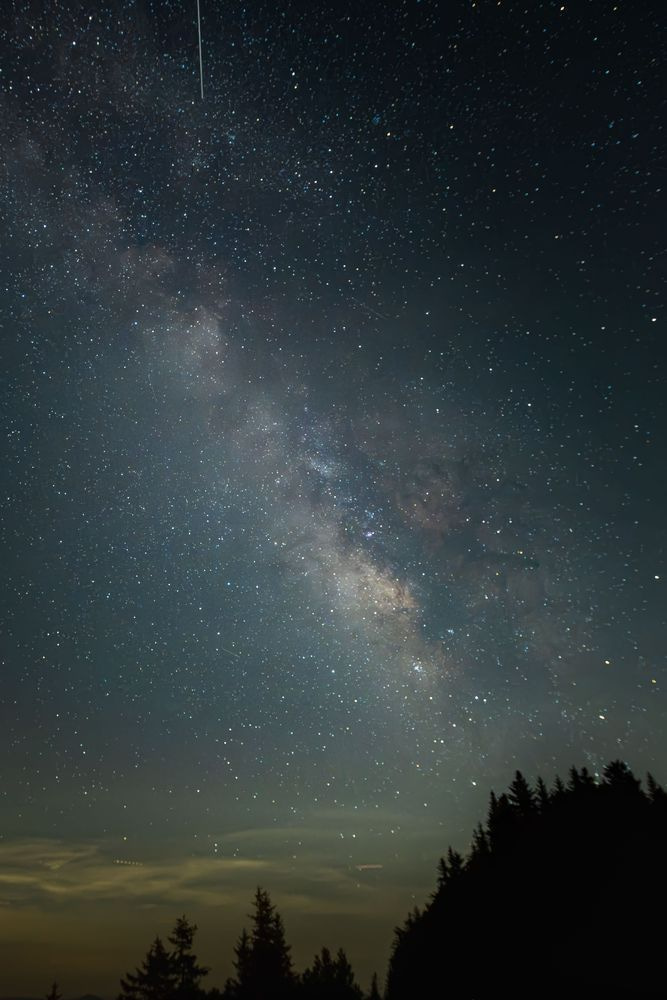
The Milky Way extends above the forested ridgeline at Waterrock Knob along the Blue Ridge Parkway, with the dense star fields and dark interstellar dust lanes of its central region visible against the August night sky. Late summer provides an important seasonal window for viewing the brighter central Milky Way from western North Carolina during the evening hours, when its position places this structure prominently above the southern sky.
Conditions at the high-elevation overlook were initially dark and clear enough to reveal substantial detail within the Milky Way despite a waxing crescent Moon approximately 14–15 percent illuminated. The photographic window was brief. Fog began moving upward along the mountains, progressively introducing atmospheric moisture that would reduce contrast and obscure the night sky.
The resulting scene records the intersection of astronomical seasonality and Appalachian mountain weather: the predictable annual position of the Milky Way set against rapidly changing atmospheric conditions along a high-elevation ridgeline.
Landscape Observation
The Milky Way dominates the night sky above a silhouetted conifer-covered ridgeline. Its brighter central region is visible near the lower-middle portion of the frame, while dark dust lanes interrupt the surrounding concentration of stars. Low cloud or fog is visible near the horizon.
Photographer's Notes
Excellent darkness at Waterrock Knob provided a strong opportunity to photograph the Milky Way. The Moon was a waxing crescent at approximately 14–15 percent illumination. The usable window was short because fog began rolling up the mountains.
The 10-second exposure at 17mm was selected to retain better definition in the stars while the f/2.8 aperture and ISO 4000 provided sufficient light capture for the Milky Way.
For the Technically Inclined
Camera: Nikon Z9
Lens: NIKKOR 17–35mm f/2.8D AF-S
Focal Length: 17mm
Shutter Speed: 10 seconds
Aperture: f/2.8
ISO: 4000
Support: Tripod
Capture window: approximately 9:55–10:05 p.m.