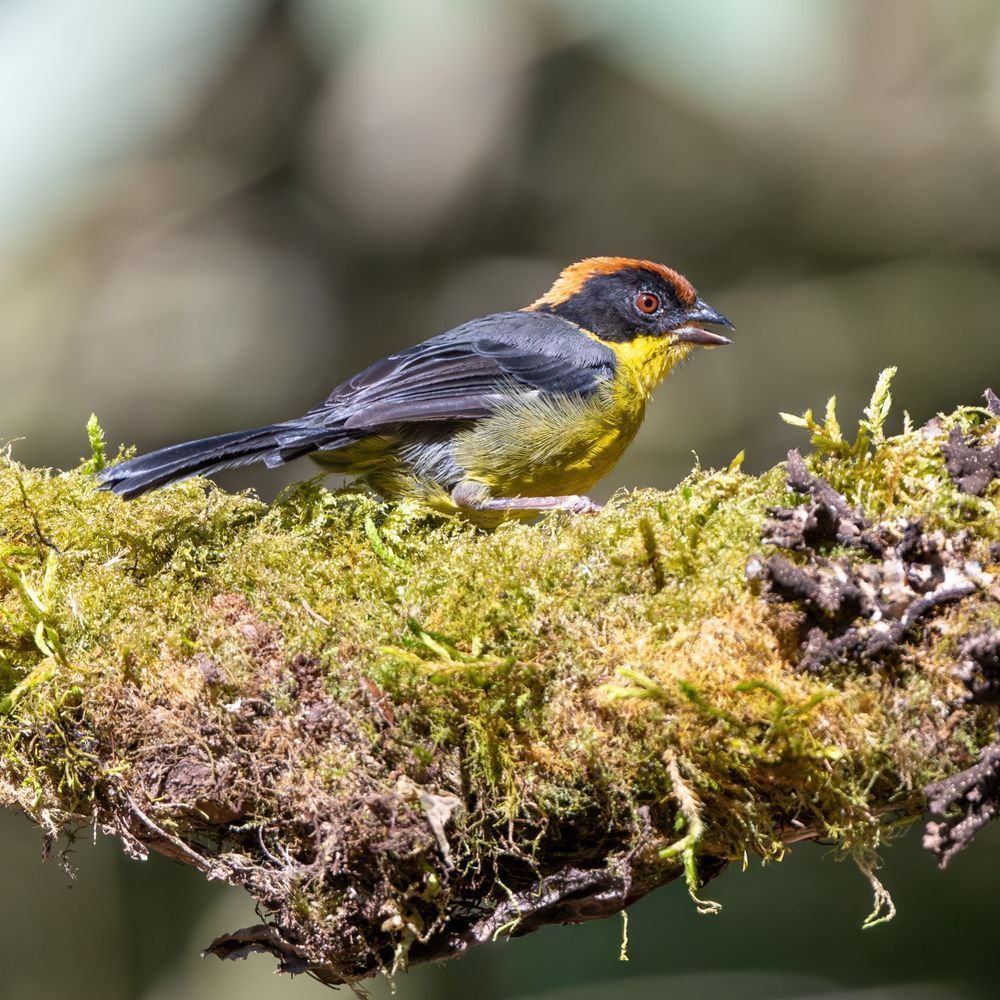
The Yellow-breasted Brushfinch typically moves deliberately through dense understory and edge vegetation, scanning bark, moss, and leaf litter for insects and other invertebrates. The moment captured here reflects a short assessment pause within that sequence, common among brushfinches as they evaluate substrate before continuing movement. Such behavior is well suited to humid montane environments where moss growth supports abundant invertebrate life.
Identification
Medium-sized brushfinch with bright yellow underparts, a dark gray to black head, chestnut crown, and contrasting olive-gray upperparts. The stout bill is adapted for mixed insect and seed foraging.
Habitat
Dense montane and cloud forest understory, forest edges, and shrubby clearings, often associated with moss-covered branches and humid microhabitats.
Geographic Range
Resident of the northern Andes of Colombia and Ecuador, primarily at mid to high elevations.
Interesting Behavior or Note
Brushfinches of the genus *Atlapetes* are known for deliberate, methodical foraging behavior close to cover. They are generally sedentary, holding year-round territories rather than undertaking long-distance migration. The Yellow-breasted Brushfinch is currently listed as Least Concern, though ongoing habitat fragmentation poses localized risks in parts of its range.
For the Technically Inclined
Camera: Nikon D850
Lens: NIKKOR 500mm f/5.6E PF
Focal Length: 500mm
Shutter Speed: 1/2500
Aperture: f/5.6
ISO: 1100
Location: Zuro Loma Reserve, Nono, Ecuador
Date: September 27, 2021