
A Meadow Full of Flowers—and Hummingbirds Still Fight Over the Feeder
Sep 20, 2026
Why Do Hummingbirds Fight Over Feeders?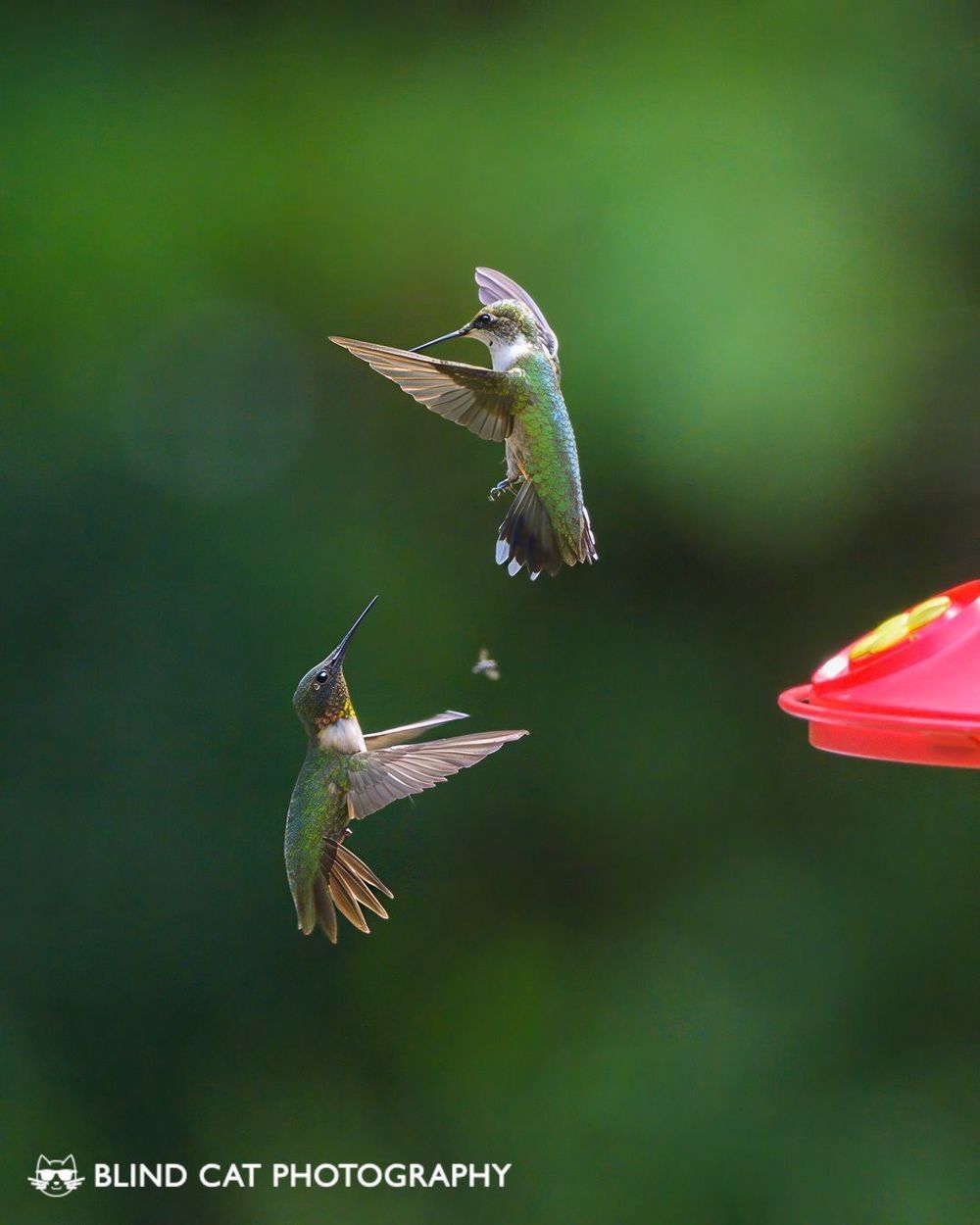
On September 5, I photographed two Ruby-throated Hummingbirds in a midair confrontation beside one of our feeders. One bird was above the other, wings spread, while the second bird faced it from below. It was the kind of encounter we regularly see around the feeders—fast, direct and over almost as quickly as it begins.
What makes the behavior especially interesting is the setting.
Over time, we converted our entire one-acre outdoor area in Franklin into a meadow planted for birds and pollinators. Native plants provide flowers, insects, seeds, shelter and natural feeding opportunities. Ruby-throated Hummingbirds readily take advantage of those resources.
But they still fight over the feeders.
The explanation isn't that they lack food. Territorial defense is simply a fundamental part of hummingbird feeding behavior.
Ruby-throated Hummingbirds commonly defend both flowers and feeders. Cornell describes males as aggressively defending these resources, sometimes resulting in aerial chases and direct confrontations. (All About Birds)
A Feeder Is an Unusually Concentrated Food Source
In a meadow, nectar is scattered among hundreds or thousands of individual flowers. Each flower also needs time to replenish its nectar after a visit.
A feeder changes that equation.
Instead of searching from flower to flower, a hummingbird finds a large, predictable supply of sugar water concentrated in one location. From the bird's perspective, that makes the feeder a resource worth controlling.
The Smithsonian notes that hummingbirds frequently defend small feeding territories because keeping competitors away can give an individual more reliable access to nectar. The same instinct applies even during migration, when a hummingbird may defend a productive flower patch during a relatively brief refueling stop. (National Zoo)
That helps explain what we're seeing in our meadow. Providing more natural food doesn't necessarily switch off the instinct to defend an especially valuable food source.
Native Flowers Still Matter
The fighting around a feeder shouldn't overshadow the importance of the surrounding habitat.
Ruby-throated Hummingbirds naturally occur around forest edges, meadows and other openings, and their diet includes considerably more than feeder sugar water. They visit flowers such as cardinal flower, bee balm, trumpet creeper, honeysuckle and jewelweed, while also catching tiny insects and spiders. (All About Birds)
That combination is one reason we've moved toward creating habitat rather than simply putting out feeders.
Our meadow gives hummingbirds many places to forage instead of relying on a single artificial food source. Native nectar-producing plants also support insects and other pollinators, adding another layer to the food web. The Smithsonian recommends nectar-producing plants such as cardinal flower, bee balm, jewelweed, Eastern columbine and trumpet honeysuckle as part of a bird-friendly landscape. (National Zoo)
The feeder is therefore just one small part of a much larger habitat.
September Adds Another Dimension
The September 5 date also matters.
By late summer and early fall, Ruby-throated Hummingbirds are entering their southbound migration period. Cornell notes that males may begin migrating as early as August, with the species leaving eastern North America for its wintering grounds in Mexico and Central America by early fall. (All About Birds)
For a migrating bird, finding dependable food sources is especially important. Nectar and feeder sugar water provide carbohydrates, while insects supply protein and other nutrients.
Our meadow and feeders can therefore serve different but complementary purposes: flowers and insects provide natural foraging opportunities across the landscape, while feeders provide a predictable, concentrated source of energy.
And a concentrated resource is precisely the sort of thing a hummingbird may decide is worth defending.
A Native Meadow Doesn't End the Battle
When we began converting our outdoor area into native habitat, the goal wasn't to eliminate feeders. It was to create something much broader—a place where birds and pollinators could find natural food and cover throughout the landscape.
Watching Ruby-throated Hummingbirds use the flowers tells us that part is working.
Watching them return to the feeders and immediately begin chasing one another tells us something else: creating abundant habitat doesn't erase millions of years of instinct.
A hummingbird surrounded by food may still see another hummingbird approaching its feeder and respond exactly as its biology tells it to.
This is my food. Go find your own.
And a few seconds later, both birds may be back among the flowers.